C. Capacitor
Symbol names: CAP, POLCAP
Syntax:
Cnnn n1 n2 <capacitance> [ic=<value>]
+ [Rser=<value>] [Lser=<value>] [Rpar=<value>]
+ [Cpar=<value>] [m=<value>]
+ [RLshunt=<value>] [temp=<value>]
It is possible to specify an equivalent series resistance, series inductance, parallel resistance and parallel shut capacitance. The equivalent circuit is given below:
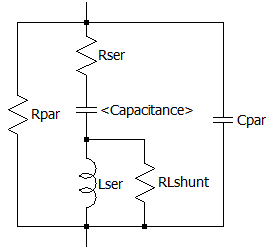
Capacitor Instance Parameters
| Name | Description |
|---|---|
| Rser | Equivalent series resistance |
| Lser | Equivalent series inductance |
| Rpar | Equivalent parallel resistance |
| Cpar | Equivalent parallel capacitance |
| RLshunt | Shunt resistance across Lser |
| m | Number of parallel units |
| temp | Instance temperature(for tempcos in a corresponding .model statement) |
| ic | Initial voltage |
Note that since the capacitor element includes these parasitics, it is useful for macromodeling the fundamental of a piezoelectric crystal.
The parameter m can be set to zero to remove a capacitor from a simulation.
If an initial voltage (ic) is provided, LTspice will apply this as a constraint for the initial operating point solution for Transient (.tran), AC(.ac), Noise (.noise), Transfer Function (.tf), and DC Operating Point(.op) simulations. Initial voltage is ignored for DC sweep (.dc) simulations because these simulations are intended to analyze the DC response to a swept source or parameter, not constant initial conditions.
Nonlinear Capacitor
There is also a general nonlinear capacitor available which specifies charge instead of capacitance.
Syntax:
Cnnn n1 n2 Q=<expression> [ic=<value>] [m=<value>]
There is a special variable, x, that means the voltage across the device. Therefore, a 100pF constant capacitance can be written as
Cnnn n1 n2 Q=100p*x
A capacitance with an abrupt change from 100p to 300p at zero volts can be written as
Cnnn n1 n2 Q=x*if(x<0,100p,300p)
This device is useful for rapidly evaluating the behavior of a new a hypothetical charge model for, e.g., a transistor.
Copyright © 1998–2025 by Analog Devices Inc. All Rights Reserved.